


Having spent the last five years building in the sustainable fashion space, I have been inundated with questions about the damning allegations surrounding Phoebe Gates, Sophia Kianni and Phia.
I was reluctant to pile on but after this week’s Bloomberg article detailed just how intentional their actions were, I want to articulate my views on why this news is so frustrating to those of us trying to solve real problems in this space.
My hope is to redirect the noise into a productive conversation about the state of the fashion industry, why we keep finding ourselves in these messes, and provide some optimism about what comes next. If anything I share here resonates, I would love for you to check out what we are building at Beni and join our efforts to reimagine the industry that shapes how we all get dressed.
With that, let’s dive in.
I didn’t set out to start a company. I got obsessed with solving a problem.
We have enough clothing on this planet to dress the next six generations, but the fashion industry is extraordinarily good at convincing us that what we need is more.
More trends. More drops. More deals. More reasons to buy something today that we didn’t even know existed yesterday. The companies who can move the fastest and spend the most win, while the brands obsessing over quality and craft struggle to survive. What’s left is a world with more stuff and less style than ever before…’enshittification’ on full display.
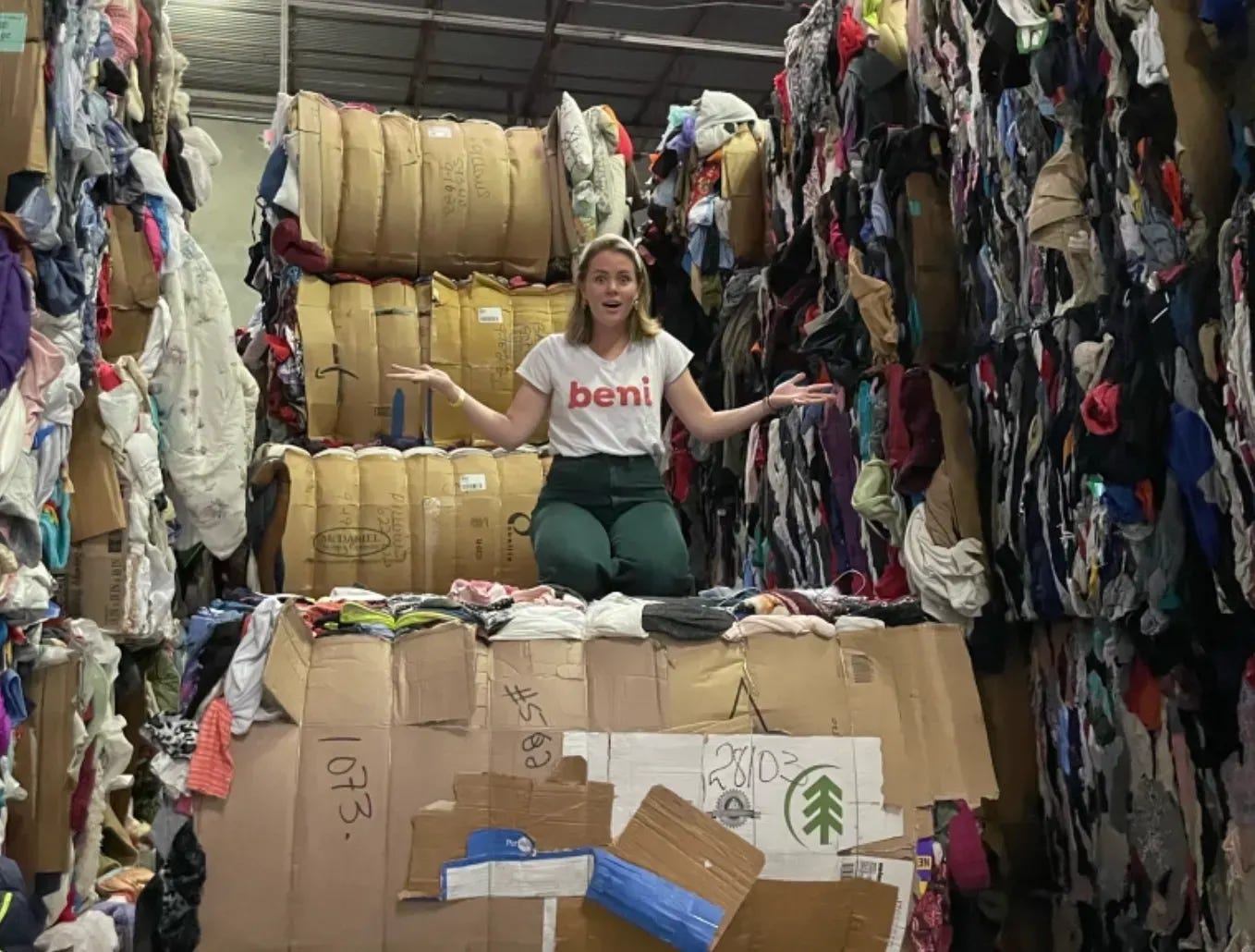
I spent the first decade of my career marketing some of the biggest brands in the world, so I understand how the machine works. I have spent the last five years building Beni because it’s clear that the machine is broken for shoppers like me and the brands I long to discover.
I started thrifting because I love the thrill of finding a great deal, but as I got deeper into building this business I started to see the power of secondhand to transform the dynamics that shape the fashion industry.
Secondhand provides a unique opportunity to align incentives to the shopper rather than the advertiser. When you have access to the full catalog of available inventory, you can focus on routing people to the best option instead of whichever brand is paying the most to be there. In theory, this transforms the pay-to-play model into a meritocracy and allows the best products to rise to the top.
So what’s the problem? The dominant discovery platforms are powered by ads and ad-based discovery doesn’t work well for secondhand.
The marketing playbook simply isn’t designed to support one-of-one listings. While you can spend millions advertising the same new jacket, you can’t spend millions advertising one single vintage handbag. So even though there is more energy than ever for resale, most people default to new because it is easier to access.
In other words, the thing holding back secondhand isn’t desire, it’s effort. Which is exactly why we started with a browser extension. It surfaces secondhand alternatives right where people already shop. No behavior change required, just the information to make smarter choices in the moment it matters most. We were excited to see people who have never thrifted before suddenly start buying secondhand. That’s real progress!
Which brings me to Phia.
I was genuinely excited when Phoebe Gates started following us back in 2022. We were early in our startup journey, and it was cool to think that what we were building had somehow made its way in front of her.
Fast forward a few years and Phoebe launched Phia as a browser extension that looked remarkably similar to ours. I won’t pretend that wasn’t frustrating.
My first thought was pretty simple…why not fund us instead of copying us? (I reached out and never heard back…then saw they blocked us on social).
But competition is part of building any successful company, and I hoped that ultimately, more attention on secondhand would help drive our mission forward.
What disappointed me was what happened next.
Pretty soon after launching, Phia’s focus seemed to shift.
Secondhand fell out of their headlines in favor of a much more familiar shopping playbook: trend reports, coupon codes, deal roundups, and touting increased conversion rates to attract new brand partners.
None of those things are inherently bad, but watching that shift made it clear to me that Phia was more interested in profiting off of the problem than actually solving it.
When your business depends on driving transactions, the gravitational pull toward more consumption is incredibly strong. The easiest way to make money is to help people buy as many things as possible, as quickly as possible. The reality is that selling new is faster and easier than selling secondhand, but it doesn’t lead to the world we want to create.
Now think about the pressure to monetize quickly if you’ve just raised $43M dollars and need to justify a $185M valuation. Albeit a disappointing outcome, it’s a predictable evolution of their business, as challenging the existing structures requires you to take a much more comprehensive view of a complex issue.
Then came the latest allegations that Phia was cookie stuffing and faking clicks to claim sales it didn’t even drive and my jaw dropped to the floor. I don’t need to delve into every detail here as other folks have taken that on. Instead, I want to talk about what the allegations mean for the industry.
Creators, publishers and businesses like Beni spend enormous amounts of time and money earning the trust and attention that eventually helps someone find what they’re looking for. Affiliate revenue is a mechanism that allows these stakeholders to capture some of the value they’ve created.
When that attribution system is manipulated, the consequences aren’t abstract. While cookie-stuffing sounds cute, let’s be clear that it is stealing. Cooking-stuffing is stealing from small businesses, independent creators, and brands that count on that revenue to build honest businesses.
So yes, Phoebe and Sophia deserve the scrutiny they are receiving. But they are also just another symptom of a broken system where misaligned incentives can motivate bad behavior.
Regardless of what they do next, there is a much bigger problem to solve and an opportunity to be way more ambitious in designing our end game.
At Beni, we are working to design a new model for style discovery. One that doesn’t depend on creating endless demand for new production. One that helps people develop better judgement, find the best pieces, and ultimately buy less but love what they buy more. One where shoppers feel supported instead of sold to and where the best brands (NOT the biggest brands) thrive. Making secondhand accessible wherever you shop is step one.
If anything, this news cycle is just more proof that what we’re building (and how we’re building it) matters.
So if you’ve been watching all of this unfold and wondering what you can do, here’s my answer:
Use Beni. Share Beni. Tell your friends about us. Send us feedback. Introduce us to people who should know what we’re building. Partner with us. Invest in us. Challenge us to make the product better. Join our team and help us make it happen.
I keep dreaming about what could happen if even a fraction of the attention, capital and energy that goes toward helping people buy more stuff went toward helping people make better choices instead. What if it was possible to create a business that resulted in a world with less waste and more style?
We’d like to find out.
That’s the company we want to build.
That’s the industry we want to help create.
We have a lot of work to do. Time to get back to it.
- Kate
Additional Resources:
Forced clicks: Ben Edelman. The independent technical analysis that uncovered the cookie stuffing.
Phoebe Gates Knew Phia Shopping App Took Credit For Sales It Didn’t Drive. Bloomberg’s follow up to their initial reporting that dives into who knew what and when.
I almost worked at Phia: Sneha Rampalli. A deep dive into what happened and how it effects the VC landscape for female founders.
Phia & Fashion Tech’s Reality Check: Styled By Code. A thoughtful take on where the fashion tech industry is headed.
BENI forever!!! So grateful to you all for making it easy to look for second hand options, first 🫡😍
Kate, this was such a thoughtful--and graceful--response to Phia's theft. Phoebe and and Sophi'a actions were wrong (and illegal--and should be charged as such!), but I applaud you for taking a step back to critiquing the larger system at play here. Bravo to holding true to your vision and values. I know it's not always easy, but that differentiation is everything in a sea of businesses selling out.